
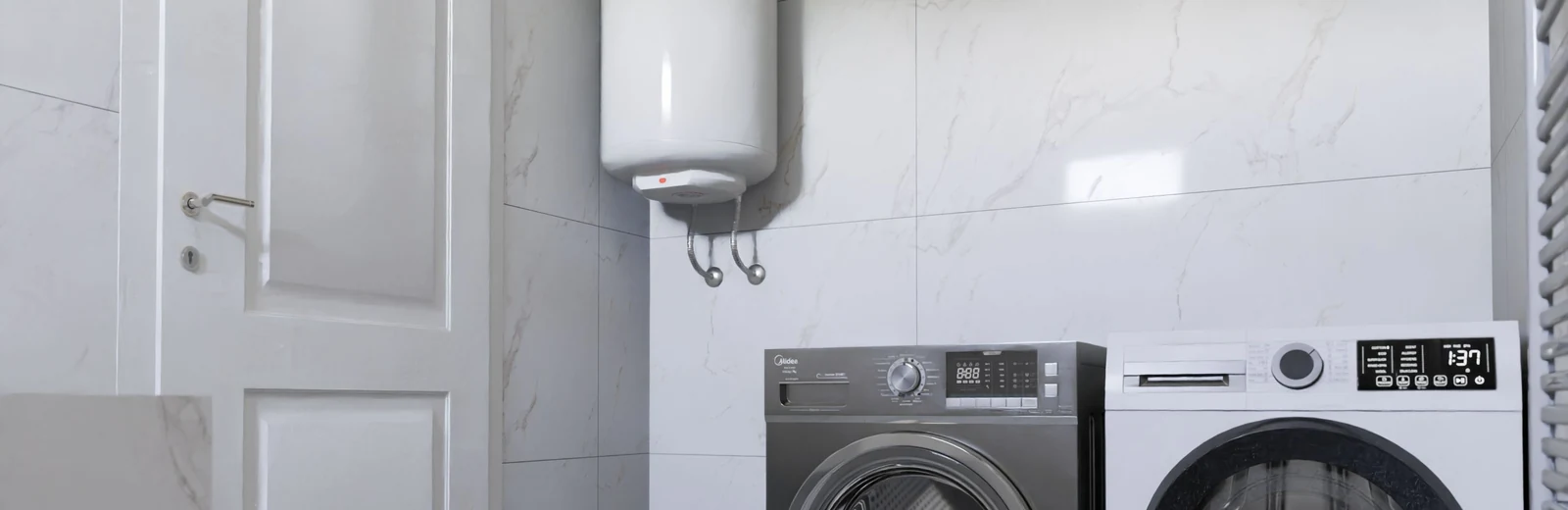
Water heater installation is the planned job of setting a new tank in place, connecting water, fuel, venting and safety devices, and testing the whole system before we leave. It is different from an emergency swap because you have time to choose the size, fuel and location.
Call (855) 575-2890 to book a visit. Our line is staffed 24/7, and we offer same-day appointments when available, but most installs are scheduled for a time that suits you.
This page covers what to decide before the day, what the installer will look at, and the permit question you should settle first. If your tank has already failed, see our replacement page.
Pre-install checklist for homeowners
Work through these points before the visit. They save time and avoid surprises.
- Know the fuel you want, and whether the house already has a gas line or a spare circuit for it.
- Measure the space, including door width, stair turns and ceiling height above the tank.
- Decide how many people use hot water at the same time, so the size can be matched to the household.
- Find the main water shutoff, and check that it closes fully.
- Take photos of the current heater, its label, the flue pipe and the piping around it.
- Call the Sidney-Shelby County Health Department about the permit question before the install date.
Moving the heater or changing fuel
A like-for-like swap in the same spot is the simplest job. Moving the heater to a garage, a closet or a different floor means new water lines, a new vent path or a new circuit, and each of those changes the scope.
Changing from electric to gas, or gas to electric, is the same. Gas needs a supply line sized for the appliance and a way to exhaust the combustion gases. Electric needs a dedicated circuit that suits the heater, and the panel has to have room. We look at both before quoting.
Unusual layouts, such as a heater in a finished basement or a crawl space, may need extra access or a pan with a drain line. We note these on the first visit and explain the choices.
The parts that make an install safe
Venting and combustion air
A gas tank needs a clear path to carry exhaust outdoors and enough air to burn cleanly. Cramped closets and shared flues can cause poor draft, so this is checked on every gas install.
Thermal expansion control
Heating water makes it expand. In a closed system with a check valve or pressure reducing valve, that pressure has nowhere to go, and an expansion tank is often added to absorb it.
Drain pan and drain line
A pan under the tank catches slow drips and can be piped to a drain. It is most useful on upper floors and finished spaces where a leak does real damage.
Relief valve discharge piping
The temperature and pressure relief valve needs a discharge pipe that runs safely to a floor drain or outdoors, with no cap and no valve on it.
Shutoff valves and unions
A full-port shutoff on the cold line and unions at the heater make future service easier. We replace corroded old ones during the install.
Call to book a visit. We cover size, fuel and location before any work begins.
Gas or electric: how they compare
Both fuels work. The right one depends on what is already in the house.
| Item | Gas tank | Electric tank |
|---|---|---|
| Needs from the house | Gas line, vent path, combustion air | Dedicated circuit and panel space |
| Safety checks | Gas leak test, draft check | Breaker, wiring and thermostat check |
| Recovery after heavy use | Often faster | Often slower, depends on elements |
| Install complexity | More venting and gas work | Less piping, more electrical work |
| Location flexibility | Limited by the vent | Wider, since no flue is needed |
A hybrid heat pump tank is another option for some homes. Ask us about space and drain needs.
Permits and the Ohio Plumbing Code
Plumbing work in Shelby County is permitted through the Sidney-Shelby County Health Department. Call 937-498-7249 to ask whether your job needs a permit, because the rules for a new install differ from those for minor repair and the department decides what applies.
Ohio's plumbing code was updated effective March 1, 2024, based on the 2021 International codes. In practice, that means an installer should work to the current code and not to what an older tank had. We install to current code, and we do not guess about local requirements.
How an install day runs
Walk-through
We confirm the plan, check the location and identify the shutoffs before touching anything.
Drain and remove
The old tank is shut off, drained and disconnected, and the area is cleared.
Set and connect
The new tank goes in its pan, with new connectors, relief valve and discharge pipe, plus gas or electric connections.
Test and walk you through it
We fill the tank, check for leaks, test the burner or elements, and show you the shutoffs and thermostat.
Setting the temperature and keeping the tank healthy
Many safety groups recommend a 120 F setting to reduce scald risk. Some households raise it for large tubs or dishwashers, so ask before you change it.
The city's 2022 water quality report listed total hardness of about 113 ppm, in the moderately hard range on the USGS scale. Minerals can settle in the bottom of a tank over time, so flushing it once a year is a sensible habit. A water softener or filter is an option if scale is a problem in your home.
What changes the price of an installation
A clear price is given before work starts, and it reflects the plan we agree on. We do not quote over the phone, since layout and fuel change the work.
Planned installations are usually a home improvement and not an insured loss. If the install follows a sudden failure, ask your insurer about the damage.
Related options in Sidney and nearby
If your current tank is failing and you are not sure it needs replacement, our water heater repair service can inspect it first. Looking at a wall-mounted unit instead? Compare it on our tankless water heater page.
We serve Sidney and nearby towns, including Piqua.
Common questions
How long does a water heater installation take?
A like-for-like swap is often done in part of a day. Moving the heater, changing fuel or adding venting takes longer. We give you a realistic window when we see the space.
Do I need a permit to install a water heater in Sidney?
Call the Sidney-Shelby County Health Department at 937-498-7249 to ask whether your job needs a permit. Rules differ from minor repair, and the health department decides what applies to your project.
Do I need an expansion tank?
Often, yes, if your plumbing is a closed system with a check valve or pressure reducing valve. We check this during planning and explain what we recommend for your house.
Can I switch from electric to gas?
Yes, if the house has or can get a gas line and a safe vent path. It is a bigger job than a like-for-like swap, and we plan it as a project.
Does a water heater need a drain pan?
A pan is a good idea in finished spaces and upper floors, and it is often part of an install. It catches slow leaks, and a drain line can carry water away.
Can I book an install for a weekend?
Our line is open 24/7 and we offer same-day appointments when available. Ask for a weekend slot and we will tell you what is open.