
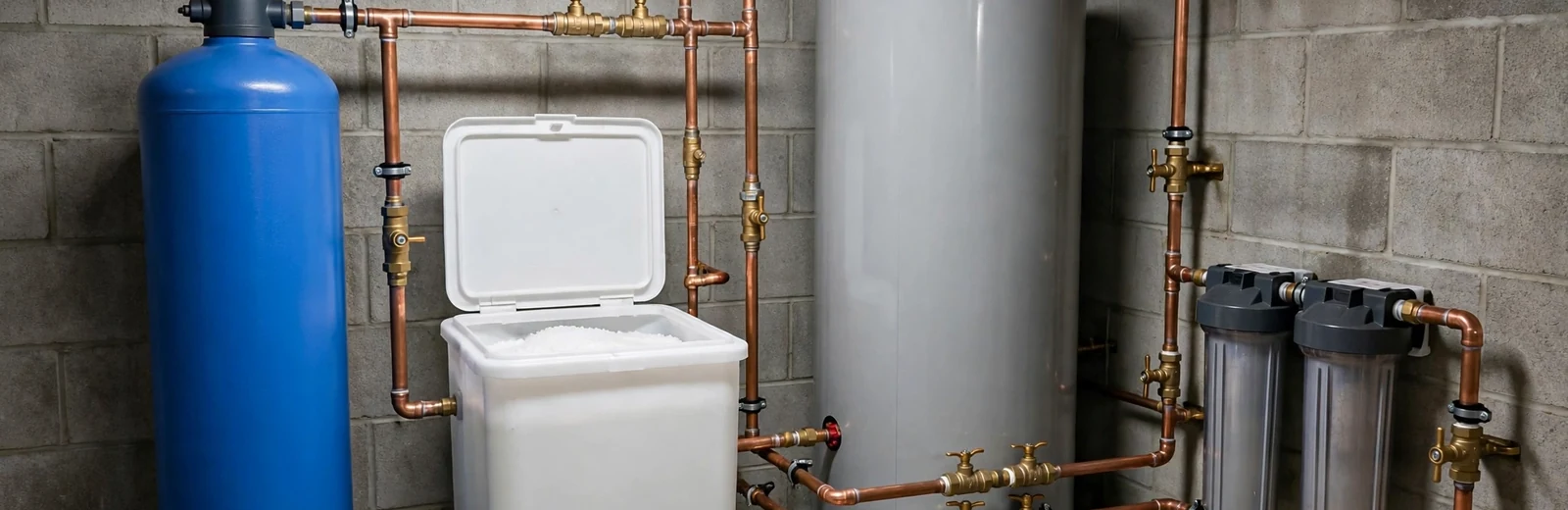
Water softener and filtration work is the choice, installation and repair of equipment that changes what comes out of your tap. A softener trades hardness minerals for sodium or potassium, a filter catches particles or tastes, and reverse osmosis pushes water through a membrane at one faucet. Our line at (855) 575-2890 is open 24/7.
The right equipment depends on what is in your water, so the first step is to test your tap. Buying equipment before you know the problem is the most common mistake we see.
This page explains what each type does, what it cannot do, and how to decide before you spend money.
Test your tap before you buy anything
A water test tells you what to treat. Hardness, chlorine taste, iron and sediment all call for different equipment, and one device does not fix them all. Ask your water utility for its latest report, and use a certified lab for a test of your own tap if you want numbers from your house.
If you are on the City of Sidney system, the city's 2022 water quality report listed total hardness of about 113 ppm, in the moderately hard range on the USGS scale. The City's 2025 report lists chlorine as the disinfectant. These are reports from different years, so treat the hardness number as history and test your tap for today.
Private well? Call the health department first
If your water comes from a private well, the Sidney-Shelby County Health Department permits and inspects private water systems. Call 937-498-7249 before you choose equipment, and have the water tested first. Bacteria, nitrate and other well problems are not solved by a softener, and a wrong choice can hide a real hazard.
Softener, filter or reverse osmosis: what each one does
These three are not interchangeable. Each does one job well and leaves other jobs undone.
Water softener
It swaps calcium and magnesium for sodium or potassium, which reduces scale on fixtures, glass and heaters. It does not remove chlorine, bacteria or most chemicals, and it is not made to make water cleaner to drink.
Whole-house sediment or carbon filter
A sediment filter catches grit and rust. A carbon filter reduces chlorine taste and odor. Neither one removes hardness, and both need cartridges changed on schedule.
Reverse osmosis at the sink
A membrane and storage tank clean water for drinking and cooking at one faucet. It removes many dissolved solids but wastes some water and does not treat the rest of the house.
Pairing them
Many homes use a softener for the whole house, a carbon filter for taste and an RO unit at the kitchen faucet. Each device does a separate job.
Test your tap and call. We will help match the equipment to the result.
Which problem points to which equipment
| What you notice | Likely cause | Usual equipment |
|---|---|---|
| White crust on faucets and glass | Hard water minerals | Water softener |
| Chlorine smell or taste | Disinfectant in the supply | Carbon filter |
| Grit or brown flecks in the water | Sediment or rust | Sediment filter |
| Drinking water tastes flat or salty | Dissolved solids | Reverse osmosis at the sink |
| Rotten egg smell | Sulfur, often from a well | Water test first, then treatment |
Equipment should match a test result, not a guess from the symptoms alone.
Repairing a water conditioner that stopped working
A softener that no longer softens usually has a resin bed that is spent, a brine tank where the salt has bridged into a crust, or a valve head that no longer cycles. Hard water at the tap despite a full brine tank points to a bridge or a stuck valve. Many units also have a bypass valve that was left open after service.
We check these simple causes first, and we tell you when replacement is the better value. A wet floor around the unit may be a loose drain line or a leaking fitting, and leak detection helps when the source is not obvious.
From water test to working equipment
Review the test
We read the report or lab test with you and match it to a type of equipment.
Size and place the unit
Household size and water use guide the size. We plan where the drain, power and bypass will go.
Install and connect
We set the equipment, connect water and drain lines, and fit a bypass so you can isolate it.
Start up and explain
We run the first cycle, show you how to add salt or change a cartridge, and answer your questions.
What changes the cost of treatment equipment
We give a price after we know what you need, since the water, the house and the equipment change the work. A clear price comes before work starts.
If a failed softener line or valve floods a floor, insurance often treats a sudden burst differently from slow seepage, so photograph the damage and ask your insurer what applies.
Hot water, heaters and treated water
Mineral scale shortens the life of heating equipment. If a tank heater is noisy or slow to recover, a water heater repair visit can check for buildup. A tankless unit is even more sensitive to scale, as explained on our tankless water heater page.
Treatment equipment ties into the main water line, so any work on it may involve a shutoff. We also serve households in Jackson Center, where the village runs its own water system, so test your tap there as well.
Common questions
Does a water softener make water safe to drink?
No. A softener removes hardness minerals, not bacteria or most contaminants. If drinking quality is your concern, ask about a filter or reverse osmosis, and test your tap first.
How hard is the water in Sidney?
The city's 2022 water quality report listed total hardness of about 113 ppm, in the moderately hard range on the USGS scale. That is a past report, so test your tap for your own current number.
I have a private well. Where do I start?
Call the Sidney-Shelby County Health Department at 937-498-7249, which permits and inspects private water systems. Have the water tested before you choose any equipment.
Why is my softener still giving me hard water?
The brine tank may have a salt bridge, the resin may be spent, the bypass may be open or the valve head may not be cycling. We check those in order, starting with the simple causes.
Does a softener remove chlorine?
No. The City's 2025 report lists chlorine as the disinfectant. A carbon filter reduces chlorine taste and smell, and a softener does not, so pick the device that matches the complaint you actually have.
Do you work on water softeners at night or on weekends?
Our phone line is open 24/7. Equipment calls are usually booked for the next open appointment, but a leak from a softener line or valve is dispatched right away, including nights and weekends.