
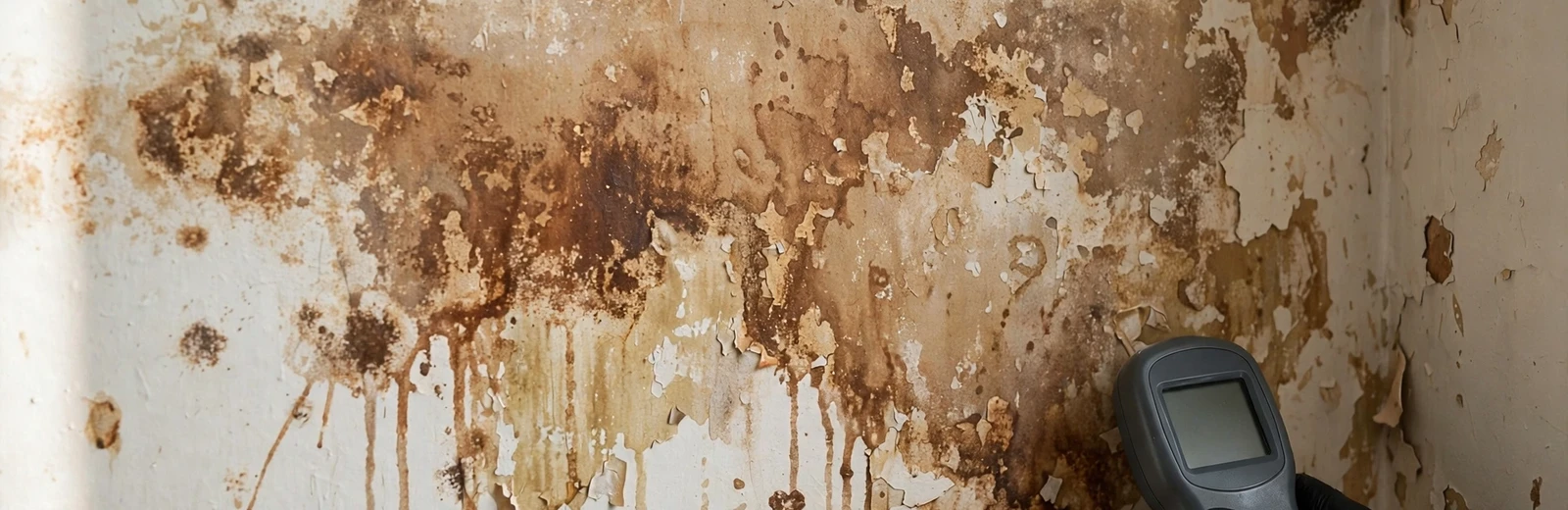
The fastest way to detect a water leak in a house is the meter test. Turn off every fixture and appliance that uses water, find your water meter, and watch the small low-flow dial or leak indicator for a few minutes. If it keeps moving with everything off, water is escaping somewhere between the meter and the fixtures.
After that, narrow it down. Check toilets with dye, look for damp spots and stains, listen for hissing and look at the area around the meter. Each step rules a source in or out, and together they usually point to the room or the line.
A hidden leak is one you cannot see. It may sit inside a wall, under a slab or in the buried pipe between the meter and the house, and it can run for weeks before a bill or a stain reveals it.
Five checks, in order
Run them in this order. Each takes only a few minutes and none needs tools.
Read the meter with everything off
Close all taps, stop the washer and dishwasher and make sure no ice maker is filling. Open the meter lid and watch the leak indicator or the smallest dial. Movement means a leak.
Shut the house valve and read again
Close the main valve where the line enters the house, then recheck the meter. If it still moves, the leak is on the buried line before the house. If it stops, the leak is inside.
Dye test each toilet
Add a few drops of food coloring to the tank, wait fifteen minutes without flushing, and look in the bowl. Color in the bowl means the flapper is leaking.
Look and feel for wet spots
Check ceilings under bathrooms, cabinet floors, baseboards and the wall behind the water heater. Soft drywall, peeling paint or a musty smell mark the area.
Listen at night
With the house quiet, listen near the meter, the water heater and under sinks. A steady hiss or faint running sound is a clue.
What each sign usually means
Clues overlap, so use this as a way to narrow the search and not as a diagnosis.
| What you notice | Likely place | Next step |
|---|---|---|
| Meter moves, house valve closed | Buried line before the house | Call, and check the area around the meter |
| Meter moves only with house valve open | Inside the house | Dye test, then check fixtures and walls |
| Color shows in the toilet bowl | Toilet flapper or fill valve | Replace the part or call for toilet repair |
| Damp patch on a ceiling or wall | Supply or drain pipe above or behind | Shut water off, call for a leak check |
| Warm spot on a floor | Hot water line under a slab | Call, do not wait |
| Unexplained jump in the water bill | Any of the above | Run the meter test |
Sidney: the meter, the line and who owns what
In the City of Sidney, the property owner is responsible for the service line from the meter pit, or the curb stop valve, into the building. The City handles the main out to the meter pit. This matters because a leak that shows on the meter with the house valve closed is on the owner's side once it passes the meter pit.
If your meter looks wrong, or you are not sure which side of the meter a leak is on, call City utility billing and describe what you see. They can tell you about the meter and your account. Do not open or tamper with the meter pit beyond reading the dial.
If the leak is outside, you may need to dig. Ohio811 requires notice before digging. Call 811 or 800-362-2764 at least two working days ahead, and up to 16 days ahead. Do this before a plumber or you start on a buried line.
Call and tell us what the meter shows. We will tell you what to do while a plumber is on the way.
Where leaks hide in a typical house
Under sinks and behind toilets
Supply lines and stop valves fail with age. A damp cabinet floor or a stain around the toilet base is the first place to look.
Around the water heater
Connections, the relief valve and the tank itself can seep. Look for rust or a wet floor beneath the tank.
Inside walls and ceilings
Pipe joints and shower valves leak where you cannot see them. A stain that grows after a shower points to the bathroom above.
The buried service line
Lines run underground from the meter to the house. A leak there may show only on the meter, or as a soft, wet patch in the yard.
Outdoor spigots
A hose left connected can split a pipe inside the wall when temperatures drop. Check the wall inside where the spigot passes through.
What you can do and when to call
You can handle
- The meter test and the shutoff test.
- The toilet dye test and replacing a flapper.
- Looking for damp spots, stains and soft drywall.
- Closing the main valve to stop active water.
Call a plumber when
- The meter moves with the house valve closed.
- The leak is in a wall, under a slab or in the yard.
- Water is spraying, or a pipe has split.
- You cannot find the source, but the bill keeps climbing.
If water is running right now
Close the main shutoff, then open a low faucet to drain the pressure. If a ceiling is bulging with water, keep clear and move belongings, since a soaked ceiling can fall. Leave electrical panels and wet outlets alone, and call a plumber.
Our burst pipe repair team answers day and night. Take photos of the damage as you go, because you will want them for an insurer.
If the meter shows a leak on the buried line, a water service line repair may be needed. The leak should be located first, so the dig is only where it is needed, and only after an Ohio811 notice.
When leak detection is worth a visit
Call when your checks say a leak exists but you cannot find it. Leak detection uses listening gear and moisture instruments to find a leak inside a wall or under a slab without opening everything. That can save a large amount of demolition.
The same steps work in Jackson Center and Anna, though each village runs its own water system, so ask your utility where its responsibility ends and yours begins. When you call us, give us the meter reading, the time you took it and what you ruled out, and we will tell you the price before work starts.
Common questions
Who is responsible for a leak between the meter and my house in Sidney?
In the City of Sidney, the property owner is responsible for the service line from the meter pit, or curb stop valve, into the building. The City handles the main to the meter pit. Call City utility billing with questions about your meter.
How do I know if the leak is inside or outside the house?
Close the main valve at the house and read the meter again. If it still moves, the leak is on the buried line. If it stops, the leak is inside the house.
Can a toilet leak without making noise?
Yes. A worn flapper can leak silently into the bowl. Food coloring in the tank will show it within fifteen minutes if you do not flush.
Do I need to call before digging to find the line?
Yes. Ohio law requires notice through Ohio811 before anyone digs. Call 811 or 800-362-2764 at least two working days ahead, and up to 16 days ahead, so lines get marked first.
Will my water bill help me find a leak?
A sudden rise with no change in use is a good clue. The meter test confirms it, and your bill history shows when it began.
Is a small leak worth fixing right away?
Yes. Small leaks soak wood and drywall over time, raise the water bill and can lead to mold. Fix them when you find them, or shut that fixture off until a plumber arrives.