
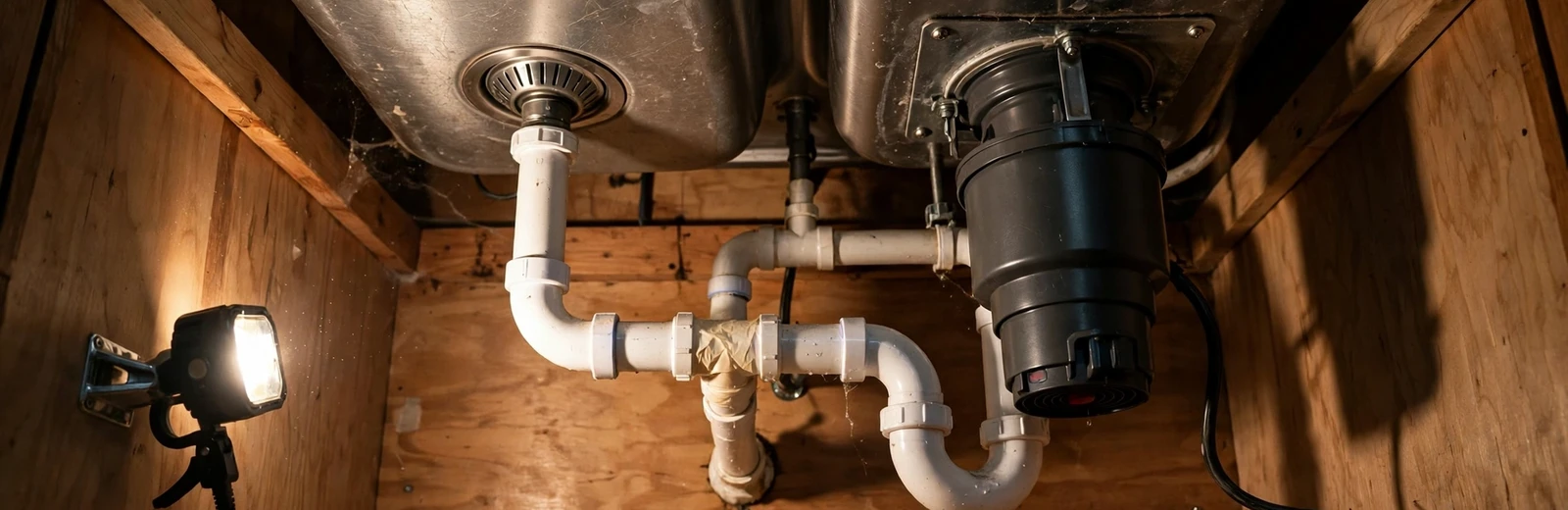
To install a double sink with a garbage disposal, you mount the disposal under one bowl, run the second bowl's tailpiece to a tee or a continuous waste fitting, and send both through one trap arm to the wall. The dishwasher drain connects to a nipple on the disposal body. A continuous-feed disposal with a wall switch is the usual choice for a household kitchen.
This guide covers the layout, the order of work and the parts that trip people up. It also marks the point where a homeowner project turns into a plumber's job, which is usually at the electrical connection or when the drain pipes need to be rearranged.
The layout in one picture
Picture two bowls, side by side. The disposal hangs under the bowl with the larger or deeper basin, because that is where you scrape plates. The second bowl drains through a basket strainer and a tailpiece, which meets the disposal's outlet at a waste tee or a continuous waste kit.
From that joint, one pipe leads to the trap, then up and across to the wall. The trap holds a water seal that keeps sewer gas out of the kitchen. Everything that leaves either bowl, plus the dishwasher drain, passes through that single trap.
The order of work
This is the general order for swapping or adding a disposal under a double sink. Product instructions come first, so read the manual that ships with your unit.
Cut power, then remove the old parts
Switch the breaker for the disposal circuit off and confirm the wall switch does nothing. Put a bucket under the trap, disconnect the old trap and tailpieces, and clean old sealant off the sink drain opening.
Set the new flange
Press a rope of plumber's putty under the sink flange, seat it in the bowl opening and tighten the mounting ring from below. Wipe off the putty that squeezes out.
Mount the disposal
Hang the unit on the mounting ring, rotate it until the discharge faces the trap arm, and lock it. Knock out the dishwasher plug if a dishwasher will connect.
Connect the drain
Join the second bowl's tailpiece, the disposal outlet and the trap arm so the pieces slope gently toward the wall. Tighten the slip nuts by hand, then a quarter turn more.
Test before you trust it
Run water into both bowls at once, then fill one bowl and release it. Look and feel for seepage at every joint, then restore power and test the unit.
Electrical caution
Turn off the breaker, not just the wall switch, before touching a disposal's wiring. Test the wires with a voltage tester. If your disposal plugs into an outlet under the sink, unplug it. If it is hardwired, or if you are unsure about the circuit, a licensed electrician or a plumber who handles the hookup should do that step.
Water and electricity share this cabinet, so wet hands, a damp floor and a half-loose wire are the combination to avoid.
Call and we will check the circuit and the drain before the unit goes in.
Parts that cause the most trouble
The dishwasher connection
The dishwasher drain hose attaches to a small nipple on the disposal. If the plug inside that nipple is not knocked out, the dishwasher cannot drain and backs up into the sink.
Mismatched tailpieces
The second bowl's tailpiece often does not line up with the disposal's outlet. A continuous waste kit with an adjustable arm solves most alignment problems.
A trap arm that slopes the wrong way
Water should run toward the wall. A sag or backslope holds water and food bits, which causes slow drains and odor.
Old sink flange sealant
Putty residue left on the sink opening creates a leak path. Clean the opening completely before setting the new flange.
Reusing worn rubber parts
Old washers and slip-joint gaskets harden over time. New ones cost little and save a return trip.
Permits and water in Sidney
Anyone doing plumbing work in Shelby County is required to apply for a permit with the Sidney-Shelby County Health Department, but minor repair work is exempt. That exemption covers cleaning stoppages and maintaining leaks, as long as pipes or fixtures are not rearranged. Whether a disposal swap counts is a question for the department, so call 937-498-7249 before you start.
The City's 2022 water quality report listed total hardness of about 113 ppm, in the moderately hard range on the USGS scale. That does not mean your home has a problem, but mineral scale can build around a disposal's flange and drain over time. Wiping the flange and running water for a few seconds after each use helps keep it clear.
Homeowner job or plumber job
Reasonable to do yourself
- Replacing a disposal with a similar model, same bowl, same drain layout.
- Swapping slip nuts, washers and a tailpiece.
- Knocking out the dishwasher plug and connecting the hose.
- Cleaning old putty and setting a new flange.
Better handed to a plumber
- Adding a disposal where there was none, with no outlet or switch in place.
- Moving the drain, relocating the trap arm or changing the sink position.
- A trap arm that will not slope correctly or a drain wall that is corroded.
- Any hardwired connection you are not comfortable making.
- Leaks that continue after you retighten, or a drain that stays slow.
Choosing the disposal itself
A continuous-feed model starts when you flip the wall switch and runs while you feed it. A batch-feed model runs only with a stopper in place. Most households choose continuous feed. Horsepower mostly affects how smoothly it handles tougher scraps, and a stainless grinding chamber resists corrosion better than a plated one.
Check the label for the mounting style. Many sinks accept a standard three-bolt mount, and the best fit is whichever ring matches your flange. If you are also replacing the faucet at the same time, our faucet repair crew can handle both in one visit.
What shapes the cost of a disposal install
We do not quote a number over the phone, since the sink and the wiring decide the work. After we see the cabinet, you get a clear price before work starts.
A disposal that fails because of a sudden jam or leak is usually handled differently by insurers than slow damage, so ask yours before you file.
When the job turns into a drain problem
A new disposal sometimes reveals a drain that was already half blocked. If water still backs up after the install, see our drain cleaning service. A professional disposal installation includes testing the full drain, not just the new unit.
Homeowners in Piqua should call the Miami County plumbing office to ask about its own permit rules, and those in Jackson Center can start with the Health Department number above.
Common questions
Which bowl of a double sink should the disposal go on?
Usually the bowl you use for scraping plates, which is often the deeper one. The second bowl drains through a tailpiece into the disposal's outlet or a waste tee, so both share one trap.
Do I need a permit to install a garbage disposal in Sidney?
Shelby County requires a plumbing permit for work that is not minor repair, and minor repair covers things like clearing stoppages and fixing leaks without rearranging pipes. Call the Health Department at 937-498-7249 and ask whether swapping or adding a disposal counts.
Why does my dishwasher back up into the sink after a disposal install?
The knockout plug inside the disposal's dishwasher nipple is probably still in place. Remove the plug, connect the hose, then run the dishwasher briefly and watch the sink and the cabinet for water.
Can I install a disposal if there is no outlet under the sink?
That is the point where most people call for help. A disposal needs a power source and a switch, and adding either is electrical work. A licensed electrician or a plumber who handles the hookup should do it.
Does a double sink need a special trap?
It needs one trap for both bowls, connected with a tee or continuous waste kit. Local code decides the exact arrangement, so ask the Health Department if your layout is unusual.
Why does the drain below my disposal smell?
Food film and scale collect on the flange and chamber walls. Clean the flange, run cold water through the disposal and check that the trap arm slopes toward the wall. Persistent odor needs a drain check.