
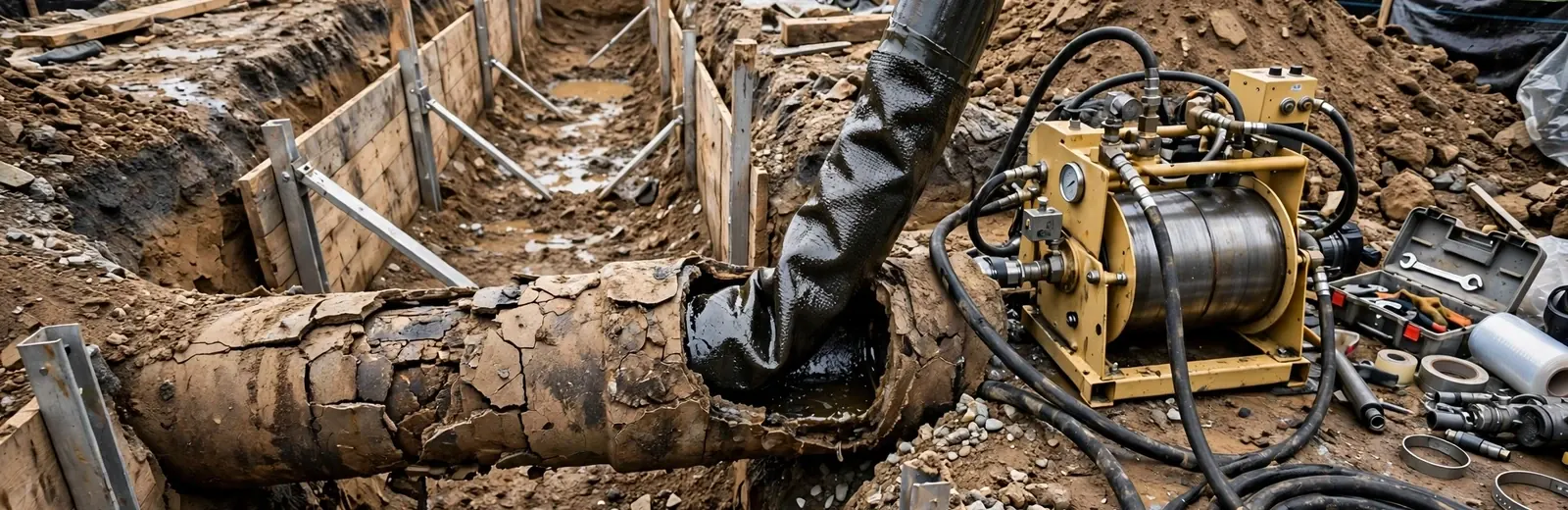
CIPP pipe lining cost depends on the length of pipe, how easily the crew can reach both ends, the amount of cleaning and prep the pipe needs, and the diameter and condition of the line. A short, straight, accessible lateral sits at the low end. A long run with bends, offsets and a collapsed section sits at the high end, or is not a liner job at all.
CIPP stands for cured-in-place pipe. A resin-soaked liner is pulled or inverted into the old pipe and cured, usually with heat or light, so it hardens into a new pipe inside the old one.
A liner often costs less than digging when the pipe is a good candidate, mostly because there is little excavation and no trench to restore. This guide explains how the total is built and how to compare a lining quote with a replacement quote.
Lining compared with dig and replace
Neither method wins every time. This table shows how they differ on the points that affect cost.
| Point | CIPP liner | Dig and replace |
|---|---|---|
| Excavation | Small access pits at one or two points | A trench along the full run |
| Yard and driveway | Usually left alone | Cut and restored |
| Pipe condition needed | Pipe must still hold a round shape and have a continuous path | Works on collapsed or missing sections |
| Bends and offsets | Limited by the liner and the resin | Can reroute and correct slope |
| Relative total | Usually lower when the pipe qualifies | Usually higher, but fixes slope and collapses |
| Disruption | Often a shorter job, with no open trench | A longer job with open ground |
Relative cost is directional. A quote after a camera inspection is the only reliable comparison.
Cost factors for a liner job
A liner price is built from preparation, materials and labor. A clear quote lists each of those, not one number, and you get it before work starts.
Insurance usually treats a sudden break differently from slow wear and tear, and many policies do not cover pipes that failed with age. Ask your insurer what applies before you choose a repair.
How a lining job runs
Camera and cleaning
A camera inspection confirms the pipe is a candidate. The line is then cleaned so the liner can bond to a clear wall.
Measure and prepare the liner
The crew measures the run and cuts the liner to length, then saturates it with resin.
Insert and cure
The liner is pulled or inverted into place and expanded against the pipe wall. Heat or light then cures the resin.
Reopen and inspect
Branches are reopened, and a final camera pass records the finished pipe. Keep that recording for your files.
Call and we will inspect the line so lining or digging is decided from evidence.
Sidney: who owns the pipe and what the City asks for
In the City of Sidney's inflow and infiltration program, the owner is responsible for the sewer from the building to the City's main and tap. That is the section a liner would replace. In a City project area that gave you a notice, owners must have the building drain and sewer inspected by video and send it to the City, so a camera inspection may be required before any lining decision.
The City also offers an optional Lateral Transfer Agreement for sewers installed before 2013. Under it, the owner pays for an inspection chamber and the City then maintains the lateral from the chamber to the main. If your sewer qualifies, ask Underground Utilities at 937-498-8157 how the agreement fits with a repair, and do that before you sign for lining.
The City's packet gives its own inspection and repair figures. We do not repeat them here, because your pipe and your quote will differ.
When a liner is not the right fix
A liner needs an intact path. If the pipe has collapsed, separated at a joint or lost its slope so water pools, lining over it locks in the problem. In those cases a short spot dig, or a full replacement, is the better path.
Liners also reduce the pipe's inner diameter slightly. For a standard residential lateral this is rarely a problem, but a plumber should check that the lined pipe still carries the flow the house needs.
Camera evidence settles these questions. A sewer inspection comes first, so the choice between liner and dig comes from the pipe and not from the quote you hoped for.
A quote checklist for lining
Before you accept a lining quote, check that it states each of these.
- The exact length and diameter being lined, tied to a camera recording.
- Whether cleaning, root removal and any needed spot repair are included.
- How access will be made, and whether a cleanout is included.
- Whether branch connections are reopened and tested.
- A final camera recording delivered to you after the cure.
- What the warranty covers, in writing, and who stands behind it.
Comparing a liner quote with a dig quote
Put both quotes next to a camera report. If the camera shows a continuous pipe with cracks or root intrusion, a liner is a fair candidate. If it shows a belly, an offset or a collapse, the dig quote is solving a problem the liner cannot.
Then compare what is restored. A dig quote should list the yard, driveway and landscaping work. A liner quote should list the access pits. Totals only compare when the scopes do.
Our sewer line repair team can price both on the same camera record. Homeowners in Fort Loramie and Botkins should check with their village on lateral rules first, since those are set by the village and not by the City of Sidney.
Common questions
What is the Lateral Transfer Agreement for Sidney sewers?
The City of Sidney offers an optional Lateral Transfer Agreement for sewers installed before 2013. The owner pays for an inspection chamber, and the City then maintains the lateral from the chamber to the main. Ask Underground Utilities at 937-498-8157 about eligibility.
How long does a liner last?
Life depends on the condition of the host pipe, the quality of the install and how the line is used. Ask the installer to put what the warranty covers in writing, and keep the final camera recording.
Can any sewer pipe be lined?
No. No. The pipe must be continuous, round enough to take the liner and clear of collapses or major offsets. A camera inspection decides whether yours qualifies.
Does lining need a permit in Shelby County?
Anyone doing plumbing work in Shelby County needs a permit from the Sidney-Shelby County Health Department, with an exemption for minor repair. Call 937-498-7249 and describe the job to ask.
Will a liner stop tree roots?
It seals joints and cracks where roots enter, which is the main reason roots return. Roots can still grow against the outside, but they cannot get in through a sealed pipe.
Is lining always cheaper than replacement?
Not always. When the pipe needs extensive prep, spot digs or reconnections, the gap narrows. A quote for each method on the same camera record is the fair test.