
A toilet that is overflowing needs your hands before it needs a plumber. Stop the flush, lift the tank lid, and close the stop valve on the wall behind the toilet by turning it clockwise. Keep children and pets out of the bathroom, then call our 24/7 line at (855) 575-2890.
Toilet repair is the work of fixing the parts that fill, flush and seal a toilet, from the flapper and fill valve inside the tank to the wax ring that seals the bowl to the floor. Toilet installation means setting a new toilet in the same spot or a new one.
We take toilet calls overnight and on weekends because a cracked tank or a failed seal can soak a floor in an hour. A slow problem gets the next open appointment, and we tell you how to hold it until then. Permit-required work follows the Ohio Plumbing Code, which was updated effective March 1, 2024.
Overflowing toilet: stop it in this order
The goal is to stop new water from entering the bowl. Do these steps in order and do not flush again to test.
Stop the flush
Do not press the handle a second time. A bowl that is rising will usually keep rising if you flush, because the drain is blocked below the trap.
Lift the tank lid
Push the rubber flapper down into its seat with your hand, or lift the float arm so the tank stops refilling. Setting the lid aside takes seconds and often ends the overflow.
Close the stop valve
Turn the oval handle on the supply line behind the toilet clockwise until it stops. If it will not turn, close the main shutoff where the water line enters the house.
Avoid contact with the water
Water on the floor may carry sewage. Wear rubber gloves and boots if you must step in it, keep it off bare skin, and wash up well afterward.
Repair the toilet or replace it
Most toilets that run, hiss or flush weakly need a part, not a new fixture. A worn flapper, a fill valve that no longer shuts off, or a loose handle chain are quick repairs. A toilet that rocks on the floor usually has a failed wax ring or a loose closet bolt, and the fix is to lift the toilet, clean the flange and set it again on a new seal.
Replacement makes sense when the porcelain is cracked, when the tank leaks from a hairline split, or when the bowl has been repaired several times. A cracked tank cannot be patched in a way that lasts. A damaged or rusted flange, the ring on the floor that the toilet bolts to, can often be repaired with a new ring so the new toilet sits level and tight.
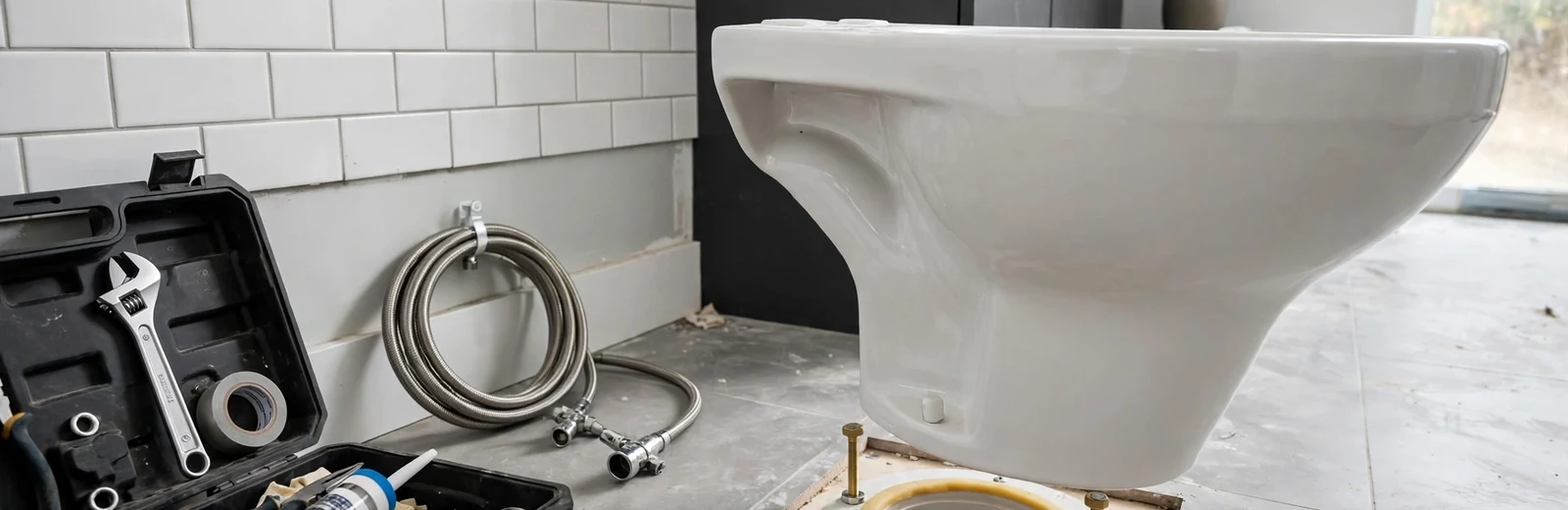
An installation follows a set order. We shut off the supply, empty the tank and bowl, and lift the old toilet. We inspect the flange and subfloor for rot, set a new wax or foam seal, lower the toilet straight down and tighten the bolts evenly. Then we connect a new supply line, open the stop valve and test several flushes.
Symptoms, likely causes and the usual fix
Use this as a rough sorting tool before you call. The real answer comes when the lid is off and the base is checked.
| What you notice | Likely cause | Usual fix |
|---|---|---|
| Water keeps trickling into the bowl | Flapper not sealing or fill valve stuck open | Replace the flapper or fill valve |
| Puddle around the base | Failed wax ring or loose bolts | Reset the toilet on a new seal |
| Wet floor with a bone-dry base | Tank crack, supply line or stop valve leak | Replace the part or the tank, or the toilet if cracked |
| Toilet rocks side to side | Loose bolts, uneven floor or damaged flange | Reseat the toilet and repair the flange |
| Weak flush or slow refill | Clogged rim jets, low water level or a partial blockage | Adjust and clean the tank, or clear the line |
A toilet that overflows on every flush is a drain problem more often than a toilet problem.
Close the stop valve behind it and call. A plumber answers at any hour.
A running toilet or a slow leak
A toilet that runs on its own, refills by itself every few minutes, or leaves a ring of damp on the floor is leaking water even when nobody is in the room. Dropping a little food coloring into the tank and waiting without flushing shows whether color reaches the bowl, which points to the flapper. Fixing it early saves water and protects the floor under the toilet from rot.
If the floor stays damp with no visible drip, a hidden supply or drain leak is possible, and leak detection can trace it.
From the call to a working toilet
Describe what you see
Tell us whether it is leaking, overflowing or only running, and whether other drains are slow. That decides what we bring.
We open the tank and check the base
We look at the parts inside the tank, the supply line and the seal at the floor before we suggest a repair.
You hear the price
You get the options and the price before work starts, including the cost-saving route of repair if the toilet is sound.
Repair or set the new toilet
We make the repair or install the new fixture, then flush it several times and check every joint for seepage.
Scale, tank parts and the Sidney water supply
The city's 2022 water quality report listed total hardness of about 113 ppm, in the moderately hard range on the USGS scale. Minerals in water of that kind can build up on flapper seats and fill valve parts over the years, which is one reason a flapper that looks fine can stop sealing.
The City of Sidney has not published a more recent hardness number that we use here, so test your tap if you want to know what your own supply looks like now. Ask the water utility for its latest report, and treat a toilet that needs flapper work every year as a reason to check the water.
What changes the price of a toilet job
We do not quote a number over the phone because the fixture, the floor and the cause change the work. After we see the toilet, you get a clear price before work starts.
Home insurance often treats a sudden overflow or burst supply line differently from slow seepage at a bad seal, so take photos and ask your insurer how your policy reads.
When more than one drain is slow
If the toilet overflows and the shower gurgles or the kitchen sink drains slowly, the blockage is likely farther down the line than the toilet. Clearing the fixture drain will not help, and plunging harder only pushes sewage back into the bathroom. A drain cleaning visit with a cable machine is the usual next step, and it is worth stopping water use in the house until it is done.
When the blockage is out in the main line, the work becomes sewer line cleaning, and a camera look tells us whether roots or a broken section caused it. We take these calls from homes in Sidney and the nearby community of Piqua as well.
Common questions
Do you handle toilet repair emergencies at night or on weekends in Sidney?
Yes. Our line is open 24/7, including nights, weekends and holidays. For an overflow or a leak that cannot be stopped, we dispatch right away. A slow problem gets the next open appointment, and we tell you how to hold it until we arrive.
Why does my toilet keep running after I flush?
Usually the flapper is not sealing against its seat, or the fill valve is not shutting off at the right water level. Both parts wear out with age and mineral buildup, and both are quick repairs for a plumber.
Can I replace a toilet myself?
Many homeowners do. The risks are a poorly seated wax ring, an overtightened bolt that cracks the porcelain, and a damaged flange. Call us if the floor is soft, the flange is broken or the old toilet will not come loose.
What causes water around the base of the toilet?
The wax ring may have failed, the bolts may be loose, or condensation or a tank leak may be dripping down. We dry the area and watch where the water first appears, so the repair targets the right part.
Is it safe to use the toilet after an overflow?
Wait until the cause is found. If the blockage is in a shared line, flushing again can send sewage back into the home. Clean affected surfaces with gloves and a disinfectant, and keep children out until it is dry.
Does installing a toilet need a permit in Sidney?
We would not guess. Plumbing work in Shelby County is handled through the Sidney-Shelby County Health Department, which does not require a permit for minor repair. Call them at 937-498-7249 to ask whether your job needs one.