
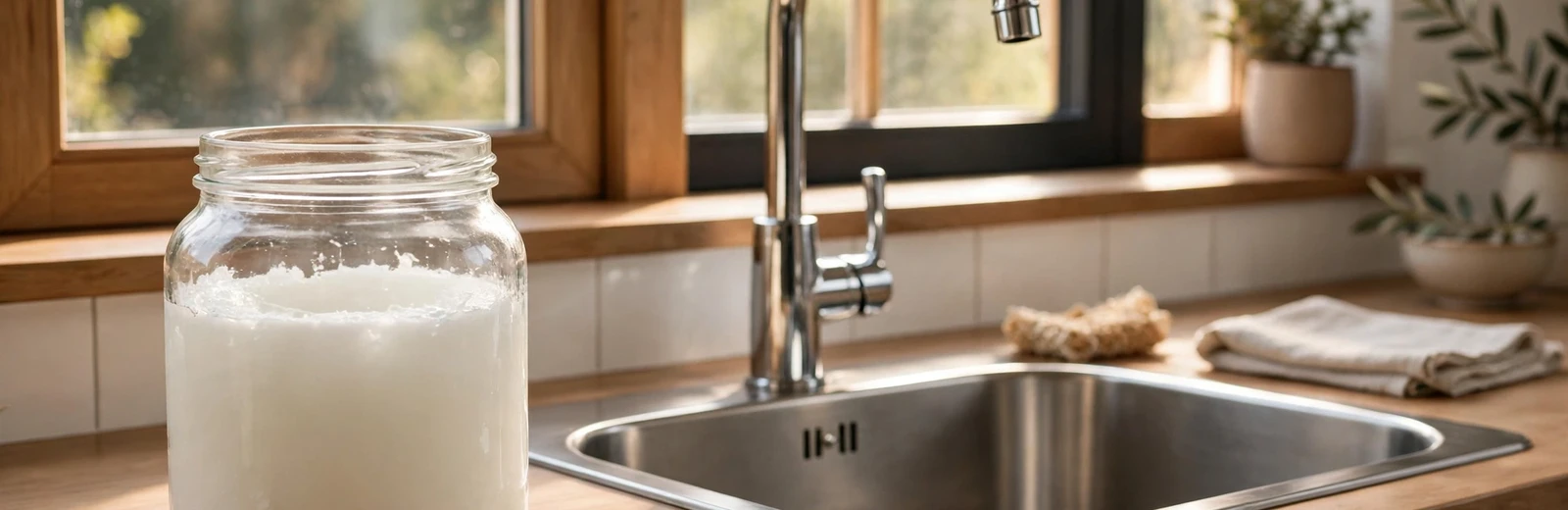
Yes, coconut oil can clog a drain. It is liquid in a warm pan, but it is close to solid at normal room temperature, and it turns firm again when it meets cool pipe walls. A little rinsed down with hot water may travel a short way, then settle and cling to the pipe, where it collects soap, hair and food scraps.
That is the whole problem in one sentence, and the rest of this post is about the details. You will see why hot water is not a fix, which fats behave the same way, what to do with leftover oil, and what to do if the sink has already slowed down. Skip ahead to the habits table if you only need the quick version.
Why a liquid becomes a plug
Coconut oil is a fat, and its melting point sits near typical room temperatures, so it can go either way depending on your kitchen. Pour it down the drain warm and it flows. Once it reaches a cold trap or a long horizontal pipe, it cools, thickens and sticks to the wall instead of moving on.
The first coating is thin. Then every pan of dishwater leaves a little more behind, and the buildup narrows the pipe. That is why a grease clog often arrives weeks after the cause. The sink drains a bit slower each month, and one day it stops.
Kitchen sink habits that help or hurt
The pattern is the same for most cooking fats, not just coconut oil. Use this as a quick guide.
| What you have | Down the drain? | Better option |
|---|---|---|
| Liquid coconut oil from a warm pan | No, it will cool and coat the pipe | Let it cool in the pan, wipe with a paper towel, put the towel in the trash |
| Solid coconut oil from a jar | No | Scrape into a sealed container and throw it in the trash |
| Bacon grease, butter, lard | No, same behavior | Pour into a can or jar, let it harden, trash it |
| Greasy pans and plates | Not as they are | Wipe out the grease first, then wash with soap |
| Small amount left after wiping | Acceptable with soap and a steady stream | Keep the pan wiped so the residue stays small |
| Large quantities of any cooking oil | No | Seal it in a container and ask your trash hauler or local program how to dispose of it |
Soap helps break up the thin film left on a wiped pan. It does not make a pour of liquid fat safe for the pipes.
Why hot water does not fix it
Hot water moves oil only as far as the water stays hot. A few feet down the pipe, the water cools to the temperature of the surrounding air or soil, and the oil follows suit. All you did was move the clog out of sight, to a spot that is harder to reach.
Garbage disposals do not help either. A disposal grinds food, not fat. Running one with oil in the drain just sends a fine, greasy slurry into the same pipes and coats the disposal's own parts as well.
Stop adding fat and call. A plumber can clear it and tell you what is coating the pipe.
Where your drain water goes in Sidney
Homes on the City sewer send wastewater to the City of Sidney Wastewater Treatment Plant at 1091 Children's Home Rd. The plant can handle household wastewater, but it cannot protect your own lateral and your own drain from a grease buildup. That part is yours, and the first place a fat plug forms is under your own sink.
Homes on septic have a different concern. Fats can float up and build a thick scum layer in the tank, and they can carry into the soil absorption area. The Sidney-Shelby County Health Department regulates household sewage treatment systems, so call 937-498-7249 and ask what should and should not go down a drain in your system.
If the sink is already slow
Stop adding fat
Skip pouring oil or greasy water down that drain until you have cleared it.
Plunge the sink
Seal the other side of a double sink or the overflow, then plunge with steady strokes. A soft grease clog can move.
Clean the trap
Put a bucket under the trap, unscrew the slip nuts by hand and clear the bend. Reassemble and run water to check for seepage.
Use a small hand auger
Feed the cable through the trap arm in slow turns. Do not force it if it stops hard, because that may be a fitting, not grease.
Call for a stronger tool
A clog past the trap or in the main branch is beyond a hand tool. That is when cable machines or hot-water jetting come in.
What you can handle and what needs a plumber
Reasonable to try yourself
- A sink that drains slowly but still moves water.
- Wiping pans and putting solid fat in the trash going forward.
- Cleaning the P-trap with a bucket underneath.
- A short pass with a hand auger through the trap arm.
Time to call a plumber
- Water backing up in more than one fixture.
- A gurgling sound after you flush or drain the sink.
- A clog that returns within days of clearing it.
- Grease buildup you suspect is deep in the line, past the wall.
- Sewage smell, or any sign the problem reaches the main line.
What a plumber does that you cannot
A plumber can run a cable machine from a cleanout or from the sink, reach past the trap and cut the clog loose. For grease, a camera can show how much coating remains on the pipe wall. If the buildup is thick, drain cleaning with a cable may clear a channel but leave a film behind.
Where the grease is heavy or the line is long, the next step is cleaning that scours the full pipe wall. Our sewer line cleaning service handles the larger lines that serve the whole house, and the same pattern of fat buildup applies there as in kitchen branches.
Habits that keep pipes clear
The habit that matters most is wiping pans before washing. A paper towel in the trash removes most of the fat. A can by the stove for bacon grease does the rest. Neither takes more than a minute, and both beat a service call.
The same advice applies in the villages around Sidney. Households in Anna and Botkins should follow one rule. Keep fats out of the sink, and ask your village office or the Health Department if you are unsure what your system tolerates.
Common questions
Can I pour a small amount of coconut oil down the drain?
A thin film left after wiping a pan is usually fine when you wash with soap. A spoonful or more poured on purpose is not, because it cools and sticks to the pipe. Scrape or wipe it into the trash instead.
Will hot water and dish soap dissolve coconut oil in the pipes?
Hot water and soap can break up a thin film on a pan, but they do not remove a built-up layer from a pipe wall. Hot water also cools quickly as it travels, so the oil can settle farther down the line.
Does coconut oil also harm a septic system?
Fats can build a scum layer in a septic tank and may reach the drain field. If you are on septic, ask the Health Department which household habits matter for your system.
Is liquid coconut oil different from solid coconut oil for drains?
Not for plumbing. Either form cools and thickens in a cold pipe. Liquid oil just takes a few more feet to do it, so the clog forms deeper in the line.
Where does the wastewater from my Sidney home go after it leaves the house?
If you are on the City sewer, it goes to the City of Sidney Wastewater Treatment Plant at 1091 Children's Home Rd. If you are on septic, it goes to your own treatment system, which the Health Department permits and inspects.
Is a grease clog covered by a quick fix like baking soda?
Baking soda and vinegar may loosen a thin film but they do not clear a real grease plug. A hand auger, or a plumber's cable, is the usual answer for a firm blockage.
How often should kitchen drains be cleaned if I cook with a lot of oil?
There is no fixed schedule. Slow drains, gurgling and repeat clogs tell you when it is time. Wiping pans and keeping fat out of the sink lowers how often you need a service call.