
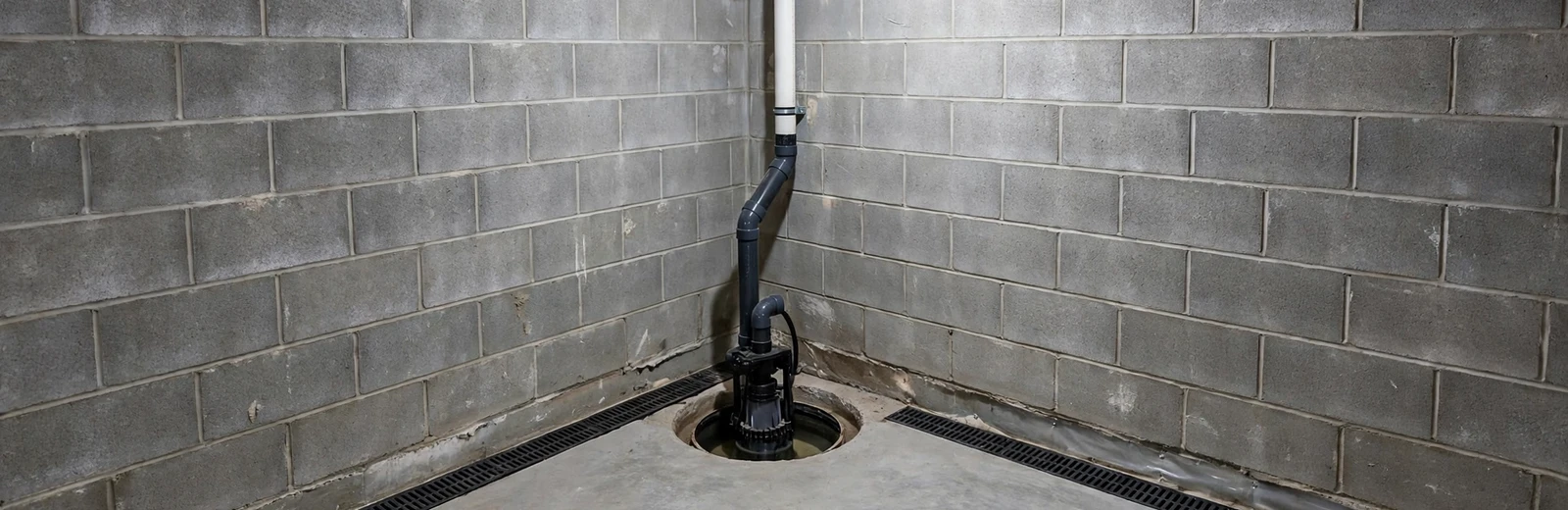
Basement waterproofing cost depends mostly on where the water gets in and how much of the house has to be opened up to stop it. Surface drainage fixes such as redirecting a downspout sit at the low end. Interior drain systems with a sump sit in the middle. Exterior excavation around the foundation sits at the high end.
Many wet basements need less than people fear. The cause is often a downspout dumping beside the wall, a leaking pipe or a sump pump that is not keeping up. Find the source first, then price the fix that fits it.
Waterproofing means keeping groundwater and surface water from entering below grade. It is not one product. It is a choice among several methods, and the right one depends on the symptom.
Start by reading the water
Where the water shows up tells you most of what you need. A damp line low on a wall after a hard rain points to groundwater pressing through a cove joint, the seam where floor and wall meet. A wet spot under a window suggests surface runoff, often from a window well or a downspout.
Water that appears on dry days is a different problem. It may come from a plumbing leak, a condensation issue or a drain line that is failing. Our leak detection service rules that out before anyone sells you an expensive system.
Take photos after the next heavy rain and note the date. A plumber or contractor can quote more accurately from a history than from a single dry visit.
Three ways to stop water, and what each costs relatively
The three methods work in different places, and their price follows how much digging or demolition each requires.
Interior drain and sump
- A channel along the footing collects water and sends it to a sump pit.
- Cuts a trench in the slab, so cost is mid-range and rises with room length.
- Keeps the exterior untouched and works through winter.
- Manages water that is already inside the wall rather than stopping it outside.
Exterior waterproofing
- Digs down the outside of the foundation to seal the wall and place a drain.
- The highest cost, because of excavation, restoration of landscaping and often hand digging.
- Stops water at the wall and is suited to a single wall or a known crack.
- Needs a contractor with excavation equipment, which is outside what a plumbing company does.
Match the symptom to the fix
Use this as a starting point. Final decisions depend on what is seen on site.
| What you see | Likely source | Typical approach | Relative cost |
|---|---|---|---|
| Wet floor near a downspout | Roof water at the wall | Extend or redirect downspouts, adjust the grade | Low |
| Damp line at the cove joint after rain | Groundwater pressure | Interior drain to a sump | Medium |
| Water at a single crack | Wall crack | Crack repair or exterior seal | Medium to high |
| Water rising from the floor drain | Sewer backup | Sewer inspection, possibly a backwater valve | Varies |
| Pump runs but floor still wet | Pit or discharge fault | Repair or replace the sump system | Low to medium |
This table is directional. We give a clear price after we see the basement.
Call and tell us where the water comes in. We will tell you honestly what fix fits.
Sidney's river and the backwater valve question
The Great Miami River gauge at Sidney recorded a record crest of 19.6 feet in March 1913, and 15.61 feet in December 2013. The National Weather Service marks 10 feet as minor flood stage. A basement near the river has a higher chance of seeing groundwater than one on higher ground, so ask what your own history shows.
The City's 2009 Flood Abatement Program says the owner maintains the service lateral and describes City assistance with installing a backwater valve for owners who have repeated backups. That document is old, so ask the City whether the assistance is still offered before you budget for a valve. The City's own plan also says inflow and infiltration exposes property owners to flooded basements.
That does not mean every Sidney basement floods. It does mean a basement near the river or with a history of backups deserves a plan that covers both the groundwater side and the sewer side.
What a plumber can fix and where we stop
We handle
Sump pump systems, interior drain connections to a pit, discharge piping, backwater valves, floor drain problems and the leak checks that rule out plumbing as the source.
We can coordinate
Downspout drainage and extensions. We can plan the discharge path and install the piping, though grading changes are yard work.
We do not do
Structural foundation repair, major excavation around a wall, masonry and concrete restoration. Those are a contractor's trade.
We will tell you
When a quote you received is for the wrong problem. A plumber who also does waterproofing sometimes sells a drain system where a gutter would do.
How to compare two waterproofing quotes
Ask what source the quote assumes
A good quote names the cause: groundwater, a crack, a downspout or a sewer issue. If it does not, ask.
Check the scope
Look at how many feet of drain, which walls, how many pits and what gets restored. The totals only compare when the scopes match.
Look at the pump and backup
Interior systems rely on a pump. Ask about the model, the check valve and a power backup.
Ask what is not included
Paint, finished wall repair, carpet and dehumidifier costs are often left out. Get that in writing.
What moves the price up or down
Waterproofing is priced by the amount of labor, the amount of material and the amount of restoration. Your clear price comes before work starts, and we write down what the work covers so you can compare it to other bids.
Insurers often treat sudden water entry differently from long-term seepage, and flood damage frequently needs its own policy. Ask what your policy covers before the next storm.
Before you sign anything
Start with the cheapest fix that matches the symptom. Check gutters, downspouts and the grade at the wall, then test the sump. If you already have a pit, our sump pump repair visit looks at the pump, the check valve and the discharge in one trip.
Neighbors in Botkins saw flash flooding in May 2019, and Fort Loramie has its own record of heavy-rain flooding near Lake Loramie, so these are not only river-town problems. Wherever you live, ask for the price in writing, ask what is not included and keep photos of the water.
Common questions
Does the City of Sidney still help with backwater valves?
The City's 2009 Flood Abatement Program described assistance with installing a backwater valve for owners who had repeated backups. The document is old, so call the City and ask whether assistance is still offered before you plan around it.
Is an interior drain or an exterior system better?
Interior systems manage water that gets in and cost less. Exterior systems stop water at the wall and cost more. Many homes need only an interior system, and some need only better downspouts.
Will waterproofing stop all moisture?
Not always. A dry floor does not mean a low-humidity room, since moisture also comes from the air. A dehumidifier is often still needed after the water problem is solved.
Do you do foundation crack repair?
No. We repair the plumbing side, such as sump systems, drains and backwater valves. Structural cracks and exterior excavation are for a foundation or waterproofing contractor.
How do I know the problem is not a plumbing leak?
Check whether water appears only after rain. If it shows up on dry days, call for a leak check. A water meter that moves with everything off is another sign.
Should I fix the downspouts before spending more?
Yes, if water appears near a downspout. It is the least expensive fix and often reduces what the rest of the system has to handle.